 |
|||||||
|
|
|
|
|
|
|
|
|
|
|
| . . Homepage. . . . What We've Been Up To. . . . About Me & Al. . . . Teddington. . . . Pictures. . . . Puzzles. . . . Puzzles Too. . . . Music. . . . Misc. . . . My Films. . . . Credits etc. . |
|
|
|
|
|

|
||||
|
|
||||
|
|
|
|
|
|
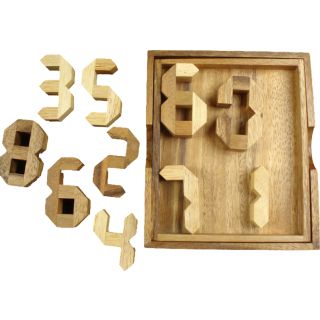
PuzzleMaster in Canada are now selling my Digigrams puzzle, still the design of which I am most proud, under the name ‘Count Me In’, made by Dave Janelle at Creative Crafthouse. Take the nine digits and zero, as seen on a digital clock, calculator or microwave oven. Assemble them into a 4x5 grid of squares as partly shown below. Flipping and rotating is allowed. Note that there is a small notch cut out of the side of the zero. Its purpose should be obvious.
Dave tells me he thinks that Count Me In is a better name than Digigrams. I disagree - what do you say? Contact me. It was an exchange puzzle at the 2000 International Puzzle Party In Tokyo, by the way. Fit the digits into the tray to form a lattice pattern. Avoid sub-standard copies produced without my permission. They fall apart and have sharp bits on them! I designed this puzzle, Digigrams, several years ago, one sleepless night looking at the digital alarm clock every few minutes for what seemed like forever. I started trying to put myself to sleep by counting the segments of each number. I eventually counted 49 segments but at this point I was still awake! I then started thinking about how to arrange those segments, and eventually in my half-awake state I realised that there were enough to form a 4x5 grid of squares. Then I started wondering if they would fit! By now I was fully awake, and, in the middle of the night I got up and started making the first prototype, from matchsticks. I strongly recommend this to you as it is such a delightfully simple idea, but very frustrating as you will soon discover. By-standers and non-puzzlers love it too, as it seems so easy... Simply (!) arrange the digits 1-9 & 0 in the tray as shown. I would welcome additional puzzles using these pieces, which I may add here. This was an exchange puzzle in 2001, presented by Patrick Major, at the International Puzzle Party in Tokyo. I have removed the picture of the original version as used in Tokyo, as it is a bit of clue to solving. The original version was made in three woods, forcing a single solution if adjacent colours must be different. (Copyright Martin H. Watson, 2000-2022, for a 2-dimensional packing puzzle, fitting the digits 1 to 9 plus zero into a 4x5 grid. Production of this design is only permitted on a single basis for personal use only. Contact me for details.) |
|
|
|
|
|
|
|
| [Homepage] [What We've Been Up To] [About Me & Al] [Teddington] [Pictures] [Puzzles] [Puzzle News] [My Designs] [Collection on Flickr] [London Puzzle Party] [POTM] [Prague Puzzles] [Prague Puzzle Shops] [Misc Puzzle Stuff] [Puzzle Suppliers] [Mailbag] [Puzzle Bags] [Puzzling People] [Puzzles Too] [Music] [Misc] [My Films] [Credits etc] |
|
|
 |
|
|
|
|
|
||
|