Something will go here one day soon...Gaiety, merriment and dancing, etc.
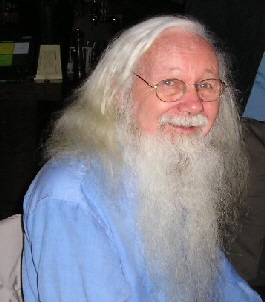
26th April 2016 - It was with very great sadness that I heard that our very good friend Robert John Reid died earlier today.
Robert’s passing seems a good time to add a few personal anecdotes to my original article below, which remains unchanged. I think Robert would have been 91 next month, May 2016. Over the last few days I have been sent many photos, and memories of Robert, from family members and friends across the globe. I will be adding much here in the next few days. You will be seeing many sides of Robert that will really surprise you, including a Peruvian chewing gum TV advert from the early 1970s, and his Spanish horror feature film debut, (the latter banned in Argentina), both of which came as a very great surprise to me. I will also add the story about when he had lunch with Fats Domino!
Thanks to Eileen, Jeffrey, Robert T., Greg, Michael, Deborah B., and others. Contact me if you have more. His funeral will be in London on 12th May. Much, much more coming soon, including the transcript of a long interview Robert gave to the Lima Mail in the 1970s, and also a 90-second extract from Robert’s screen debut in a Spanish-language horror film.
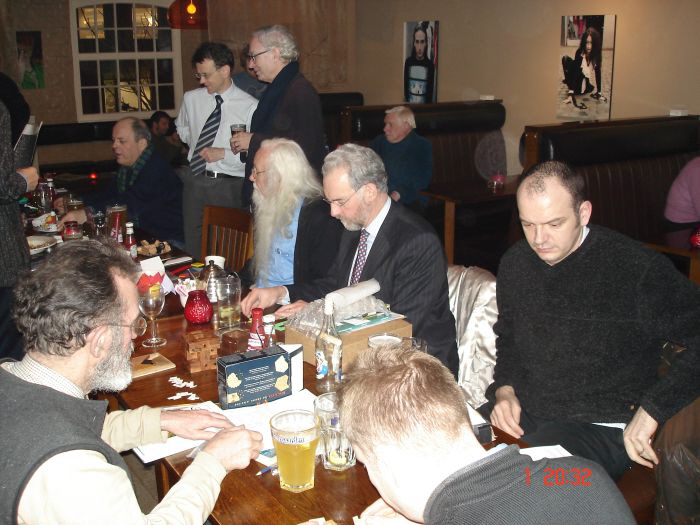
Up until 3 to 4 years ago I used to visit Robert regularly each month in his flat, and then the two of us would go on to the London monthly puzzle party. For the first 100 months he was the most regular attendee, rarely missing. Earlier in the week Robert would travel to some far-flung specialist cheese shop the other side of London to get some interesting cheese and olives and perhaps balsamic vinegar for us to enjoy together. I even recall the afternoon we had a balsamic vinegar tasting and comparison!
Above, Robert surrounded by his adoring acolytes at the monthly London Puzzle Party.
As befits any great thinker, his living room was always a crazy mass of 10 different simultaneous projects piled up on shelves, tables and armchairs. He used to have a lady from social services who would go to look after him each week, and I remember many times turning up, seeing his flat in apparent disarray, and I'd ask him if social services had failed to arrive. He always used to assure me that, yes, a nice lady had come but “... I kept her busy cutting out shapes or doing drawings for me.”
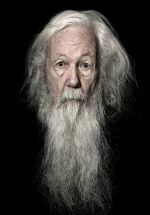
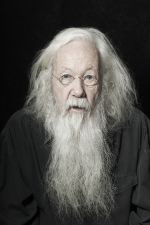
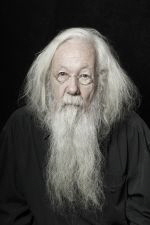
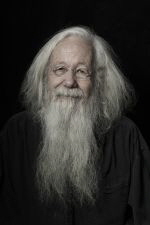
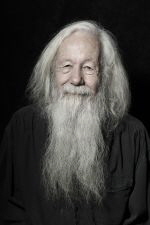
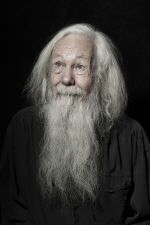
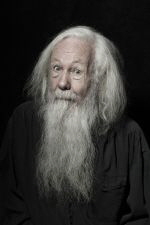
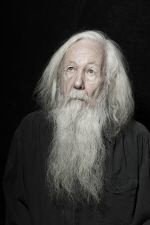
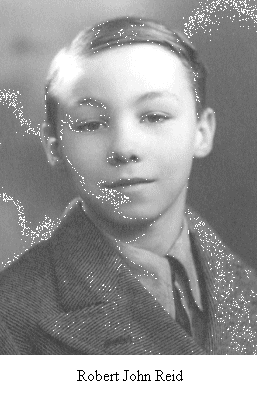
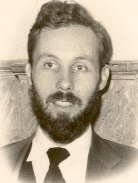
The following photos of Robert were taken by a professional photographer. One afternoon, while visiting him, Robert told me that somebody had approached him in Kilburn High Road and asked him to ‘sit’ for him. This all sounded very dubious, and I warned Robert to be very careful. It turned out that the photographer was attracted by the years of wisdom, geniality and timelessness in Robert’s face and wanted to add him to his portfolio. Sadly I am not able to accredit the unknown photographer. I think that under the photographer’s direction, Robert was an amazing subject.
In his later years Robert suffered badly from Parkinson's Disease and in the same way that you or I could draw a straight line from A to B, Robert was so shaky that it became a very crazy zigzag line looking more like some printout from an earthquake monitor. One of the side effects of his medication was that he lost his sense of smell, and for somebody who loved dining out as much as Robert, this was a great loss. It also meant that he was occasionally unaware if the cheese in his fridge was past its best, and so one of my regular chores was to inspect his fridge for cheese which had become even too pungent for his preference.
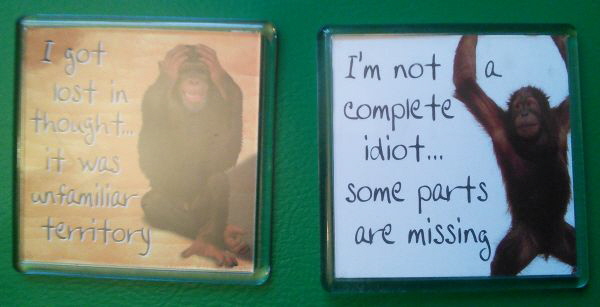
Robert had a wonderful sense of humour, and on a couple of occasions sent me fridge magnets with slogans joking about my lack of intelligence, two examples are shown here.
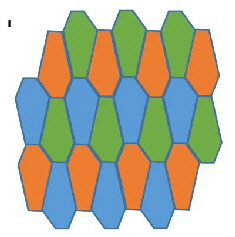
In recognition of his sense of humour I devised this tiling in his style, made from what I shall tactfully call “suitably skewed hexagons”. I know nobody will think this is in bad taste, as I knew him very well and I know he will be looking down with a wry smile on his face and a mischievous glint in his eye, at my design. RIP, Uncle Bobby.
In his living room he used to sit in his chosen armchair with his back to the wall clock. At about 4:50 he would look at me and say “Martin, how is the old enemy?” I knew he was referring to Time, and it was amazing how accurate his judgement was for when we should prepare to get the bus to the monthly London puzzle party and even in his early 80s he insisted on travelling on the top deck.
Due to the tremors from the Parkinson's disease, he was always grateful for somebody to cut his food into suitable pieces, and he had a prodigious thirst for pint-sized cups of very sweet tea.
Many times I can remember him watching a puzzler (often me...) placing tiles into a tray or using polyform shapes to fill a cube or other solid. He would look at the placed pieces, and the remaining pieces, and despairingly say “Why are you carrying on because those pieces will not fit into that remaining space”. He was a truly remarkable man and I will miss him greatly
One time I met him and he had a truly magnificent black eye. I asked him about this, and he told me that a young girl was being taunted for her style of dress, and he waded in, as a gentleman would, to defend her right to dress as she chose. Sadly he got the black eye for his troubles from her assailant.
I will miss Robert. We all will.
The following short TV advert for Chiclets Chewing Gum features a side of Robert I did not know about until this month, May 2016. Watch carefully, at 0:09-0:15 seconds, then 0:30-0:33, 0:39-0:40, and 0:58. I am told that he made at least eight of these adverts, which may also be on YouTube, but there are hundreds of them to watch. Feel free.
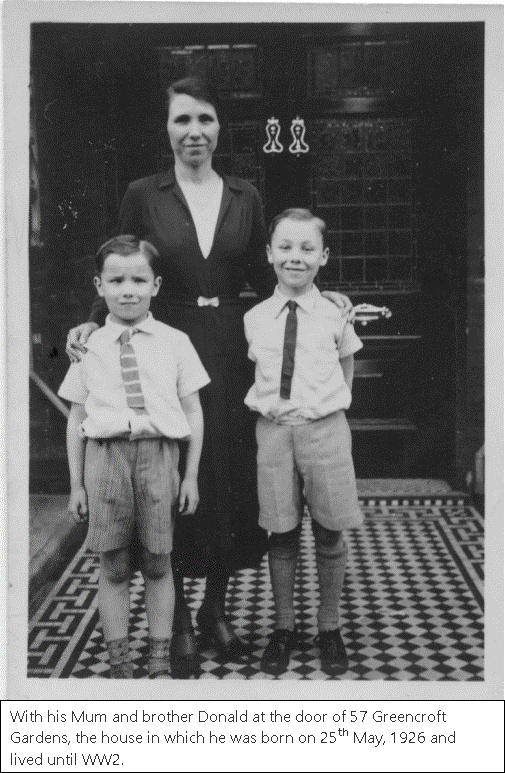
I can’t help wondering whether Robert loved that tiled entranceway above with a passion! I know I would have done at that age!
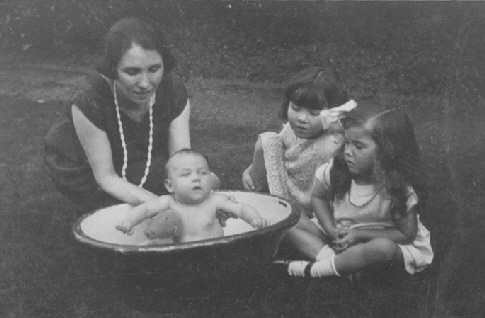
Below, enjoying (I think...) a bath in the garden while sisters Eileen and Edna avert their eyes.
In the days immediately after Robert’s passing I was sent a copy of an interview and article featuring Robert, from the Lima Mail in the mid/late 1970s. The author has given me permission to reproduce this below (to follow). The article mentioned that Robert had a small role, as an antique shop owner, in a Spanish-language Peruvian/Argentinian production, in the style of Hammer horror films. It was called ‘El Inqusidor’ (The Inquisitor) and subseqnently released as ‘El Fuego Del PecadoI’, The Fire of Sin’. I enthusiastically hunted for this gem, available in full on YouTube and valiantly watched this epic of Latino cinema to find Robert’s scene. The 90-second extract below shows Robert’s performance. Don’t miss the wonderful moment almost at the end, where Robert looks directly at the camera. Many web sites include extensive details of the film, censored in Argentina, which was considered quite radical for South America at the time. The Spanish Wikipedia article for the film wrongly links Robert to an article about a similarly-named American basketball player... Google Translate: “A series of mysterious murders of young girls in the city of Lima is being investigated by local police. The odd thing is that the girls are burned alive ... The murder of a driver with an old medieval weapon, a dagger - shaped cross, warns researchers”
I will leave you to explore the whole film at your leisure. If your preferences for horror films includes monks, cockfighting, bikinis, nudity, brutal death, violence, torture, over-acting, flared trousers, bad 1970s disco music, and every bad cultural cliche of 1970s film-making including flagellation, gratuitous smoking, religious icons, tie-dyed dresses, catacombs and cherubs, this film is definitely for you. I found the mathematical inferences of an actress inscribing a 5-pointed star in a circle in the dust particularly poignant in view of Robert’s mathematical interests. There are some fascinating scenes of 1970s Peru including at 18:15 a fascinating crypt scene and the aforementioned star at 1:12:50.
Robert delivers his lines with his tongue very firmly in his cheek, and the scene is translated as follows, by his great-nephew. I do wonder if this was actually filmed in the antique shop which Robert ran at the time, and it seems possible that it is the same setting as used for Robert’s scenes in the Chiclets Chewing Gum advert above. In the opening credits for the full film Robert is listed firstly as ‘Roberto Reid’ (1:30) for his acting role, and subsequently as ‘Robert Reid’ (2:13) for his 'escenografia' or scenography work.
ROBERTO: Beautiful.
MAN: True. Fantastic.
ROBERTO: It was made 2,000 years ago [for a civilization prior to the Inca]. So how can I help you?
MAN: I'm an official named Vasquez. I would like your opinion on this.
ROBERTO: A nice piece. And very valuable. But it's a pity that it's incomplete.
MAN: Incomplete?
ROBERTO: Yes, it's missing the crucifix. This is the top part [on which would be the Christ]. This is a piece from 1500 to 1600. Notice the green colour of the stones. This is distinctive of the Inquisition period, an era of persecution of witches and others, as you know.
MAN: Who collects these types of pieces?
ROBERTO: Oh, there are many private collectors in Lima. I know some, they are our clients. [Go see] Father Leonardo in the convent [of Las Descalzas]. He is an expert and knows most of them.
MAN: I will go see.
ROBERTO: Out of curiosity, where did you obtain it?
MAN: A man died with it.
ROBERTO: Only one? I would say many and long ago.
My original biography from about 2010:
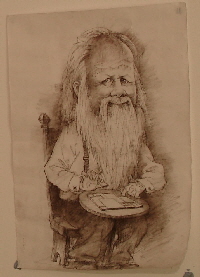
The first time I ever met Robert Reid, who obviously has a portrait of himself in his attic, I was in Village Games in Camden Lock Market, London. I listened to his conversation with proprietor Ray Bathke. Robert immediately struck me as a unique, interesting and truly gentle man. Ray introduced us and we spoke for a while before Robert left. Ray then filled me in on Robert’s background as one of the great unknown recreational mathematicians of our age. He has lived for most of his life in Peru, only recently coming back to London.
A year or two later my friend Fred told me over a pint or few that he had met a really interesting man at Kevin Holmes’s puzzle stall in Covent Garden. I quickly realised that it had been Robert. Fred maintained contact with Robert, and one Saturday in August 2001, the three of us met up in a wine bar in Covent Garden, for an afternoon of puzzles and tessellations, which finished well into the evening at a Spanish restaurant in South London. That day, looking through an unbelievable collection of Robert’s lifelong work inspired me to design some tessellating shapes of my own. I don’t often blow my own trumpet, but on seeing these tessellations a few weeks later, he said, “I am in awe of this man.” (In Antwerp in August 2002 Robert made the addendum to this statement, “I didn’t say whether I thought you were awful or awesome.” Thanks for that, Robert!
Subsequently Robert and I have met many, many times and he never fails to astonish me with his ingenuity, wit and his life story in general. He is probably (at least in my opinion) the most revered and illustrious former pupil of Arnold House School, London, with a well-deserved world-wide following in recreational mathematics, 3D dissections, tessellations and number theory, and was later educated at The King's School, Canterbury. He has travelled in Europe and the United States, expanding the horizons of fellow mathematicians, often many years his junior. He has contributed articles to Martin Gardener, formerly of Scientific American magazine for almost 40 years. He has acquired many friends over the years, all intrigued by this gastronome, wit, raconteur and bon viveur.
I must document the story he told me about when he danced with ‘a beautiful vedette’ at the Moulin Rouge in Paris….
Some of Robert’s work is discussed in Greg Frederickson’s ‘Dissections, Plane and Fancy’. See my books page.
Fred and I joined Robert Reid for the afternoon of Robert's 76th birthday, at which I presented him with a set of my Seven Deadly Sins puzzle.
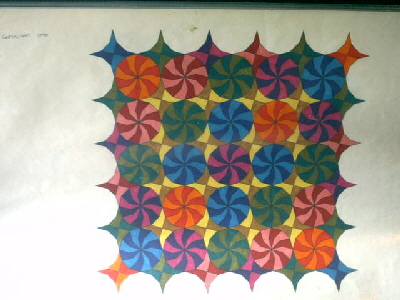
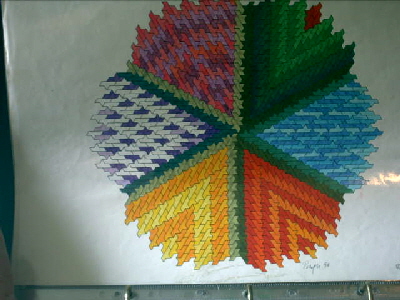
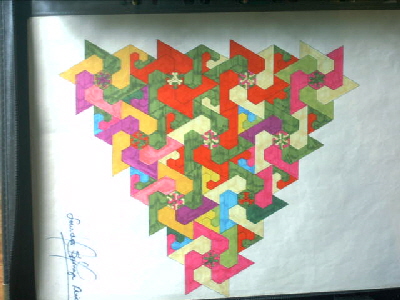
In August 2002 Robert gave me access to his entire portfolio of tessellations, for which I am truly grateful. This portfolio consists mainly of A3 pages of highly intricate tessellating designs, drawn by Robert over the last twenty years and hand-coloured by a wide cross-section of people who Robert met in Peru. Many people enjoyed the originals when he displayed them in Antwerp in August 2002. The whole range of society is covered including children, adults, teachers, farmers and even a couple of drug addicts. Robert is concerned that his designs might be misappropriated and used commercially without his permission. As he puts it, “I don’t want to see them on T-shirts.” Personally I’d love to design something that was beautiful enough to be used commercially, but in order to respect his wishes I am only displaying low resolution thumbnails of his work.
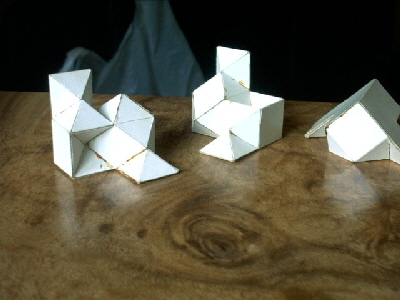
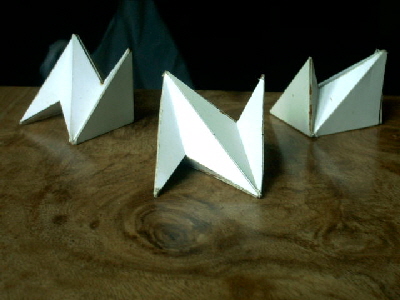
Robert has also designed a set of 10 three-piece dissections of a cube, where each cube is split into three identical pieces. These photographs are of the cardboard models that he made several years ago. Each picture shows the three pieces, positioned at different angles to give a clear idea of each. Click here, to see the full set, but before you do so, try to think how you would cut a cube block of, say, hard cheese into three identical pieces which assemble to a cube. There are probably very few who can think of more than one (very obvious) way. Robert found ten.
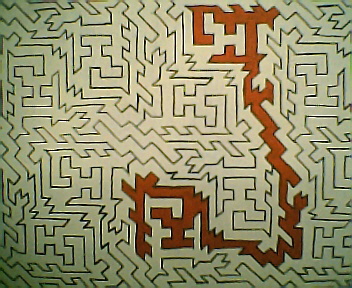
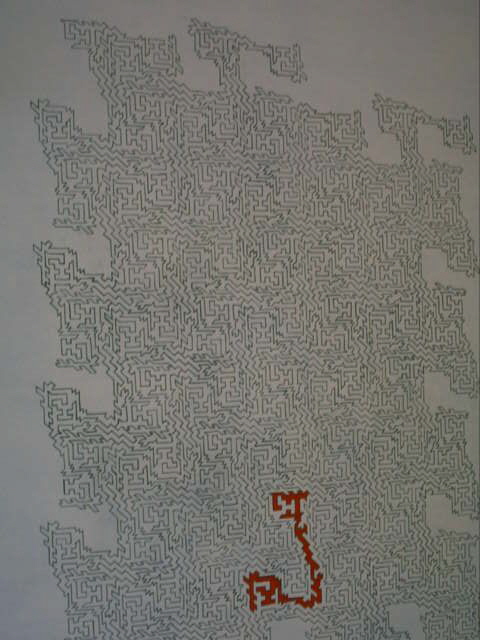
This next picture shows what, at first glance, appears to be a very large and intricate maze. It covers an area of about 3x4 feet. Actually it is a tessellation made from many replications of the red shape!
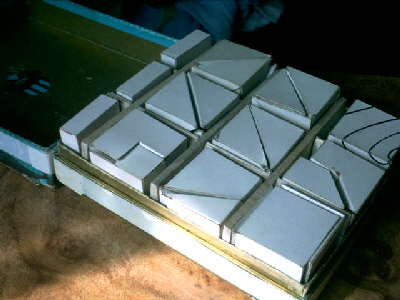
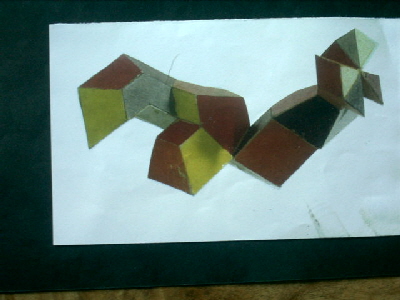
Here is a solid, designed by Robert, with the goal of producing the most irregular 3D object which will pack infinite space without any gaps. This picture doesn’t do it justice, being a photograph of a photograph of the object. I feel privileged to have handled it!
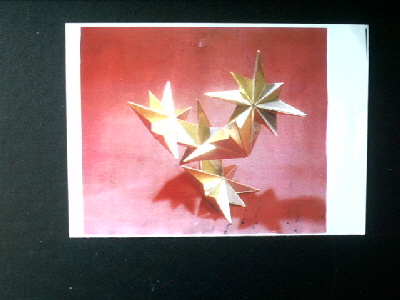
Finally, at least for now, this picture shows ‘Le Coq’ a paper sculpture formed by cleverly combining several identical intricate stellated polyhedra designed by Robert.
Much, much more coming soon, including the transcript of a long interview Robert gave to the Lima Mail in the 1970s, and also a 90-second extract from Robert’s screen debut in a Spanish-language horror film.
I started this web site in about 1998. As of Autumn 2016 it is getting its biggest ever refurbishment.
My goals are to include more current information, more pictures, no dead links, consistent format and typeface, better readability on more screens, and to get rid of characters that display badly. But no free beer.
It is a bit untidy and experimental ...but just wait...